How tanning beds work and whether they are safe to use

A golden tan even in winter, an even skin tone without "white marks", the feeling of a vacation among working days - all this attracts many people to tanning salons. Artificial tanning has been part of the beauty industry long before the Instagram era, but in recent years the debate about its safety has become increasingly heated. Medical studies point to a link between artificial UV radiation and an increased risk of skin cancer, while tanning bed manufacturers assure that their equipment is safe when used correctly.
Want to get a bronzed skin tone but worried about the potential risks? Choosing between natural pallor and artificial tanning is always a matter of balancing your desired beauty and health. In this article we will tell you how modern tanning beds work, what advantages and disadvantages they have, and how well-founded the fears of doctors are.
We offer you an objective analysis of the principles of tanning beds and scientific data on their effects on the body. With proven information, you will be able to make an informed decision about whether to include artificial tanning sessions in your beauty ritual and how to do it as safely as possible.
The principle of operation of a solarium
A solarium is a special device equipped with ultraviolet lamps that emit light close in spectrum to the sun, but with controlled intensity and ratio of different types of ultraviolet light. It is this radiation that causes the appearance of tanning - the skin's protective response to ultraviolet light.
Modern tanning devices are divided into two main types: horizontal (lie-flat booths) and vertical (capsule booths). Horizontal tanning beds provide a more even tan because the body is in a relaxed position, but they take up more space and cost more. In vertical tanning beds, the client stands, which allows you to achieve a more intense tan in less time due to the tighter arrangement of the lamps. Modern vertical models are equipped with 40-60 lamps with a power of 100-200 watts each, which provides impact on the entire surface of the body with minimal "shadow" areas.
The key characteristic of any tanning bed is the spectrum of ultraviolet radiation used. The lamps generate two types of ultraviolet light: UVA (long-wave, 315-400 nm) and UVB (medium-wave, 280-315 nm). UVA rays penetrate deep into the skin, causing a rapid darkening of existing melanin, but this tan usually doesn't last long. UVB rays penetrate less deeply but stimulate the production of new melanin, providing a more permanent tan. In modern tanning beds, the ratio of UVA to UVB is usually 95:5 or 98:2, unlike natural sunlight where the ratio is about 95:5 in summer and 98:2 in winter.
The main characteristics of modern tanning beds are:
- Lamp power: from 80 to 200 watts, which determines the intensity of radiation
- UVA/UVB ratio: from 98/2 to 95/5, which affects the speed of tanning and its persistence.
- Number of lamps: from 20 to 60, depending on the model and size of the cabin
- Cooling system: air or water, maintains a comfortable temperature of 22-28°C
- Filters: special glasses that cut off dangerous wavelengths below 280 nm (UVC)
- Eye protection: built-in or removable goggles that block 99% of ultraviolet light
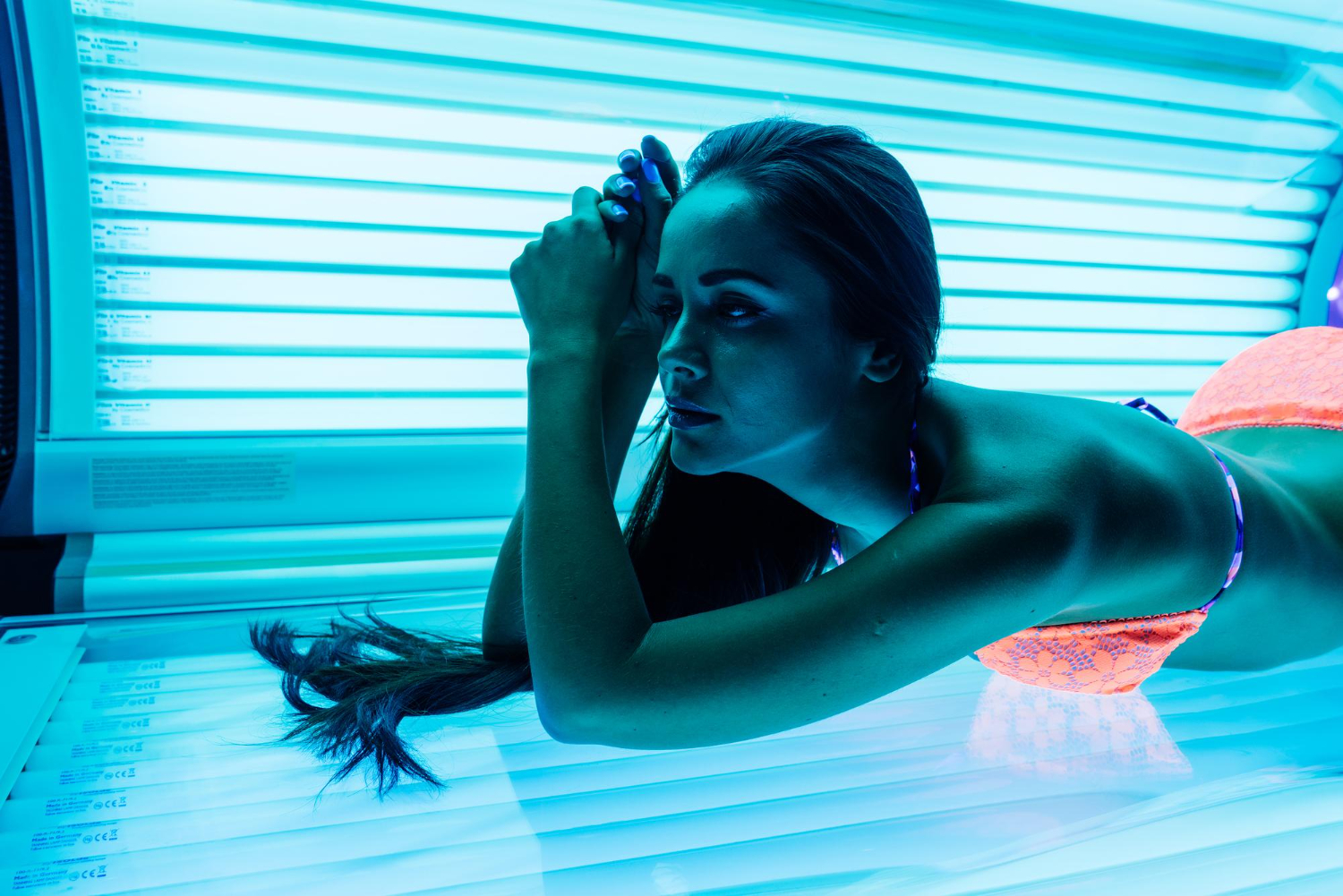
Sunbed tanning process
A tan in a tanning bed is formed by the same biological mechanism as at the beach - it is the body's protective response to ultraviolet radiation. When UV rays penetrate the skin, they affect melanocytes - cells located in the basal layer of the epidermis. In response to this exposure, melanocytes begin to more actively produce the pigment melanin, which absorbs UV light, preventing DNA damage deep within the skin.
There are two main processes of tan formation. The first is IPD (Immediate Pigment Darkening), where the melanin already present in the skin is oxidized by UVA rays and darkens within minutes to hours after exposure. This effect is noticeable after the first session, but fades quickly. The second process is Delayed Pigment Darkening (DPD), in which UVB rays stimulate the production of new melanin. This process begins 48-72 hours after irradiation and peaks on day 7-10. It is DPD that provides a durable tan, which can last up to 3-4 weeks.
The key difference between tanning in a tanning bed and natural sun tanning lies in the spectral composition of the radiation. Most modern tanning salons use lamps with high UVA (up to 98%) and low UVB (2-5%), which ensures a quick tan with less risk of burns. However, this tan lasts less than a sun tan, where the UVA/UVB ratio is more balanced. In addition, the intensity of radiation in a solarium can be 10-15 times greater than the midday sun at the equator, which significantly reduces the time needed to get a tan - from several hours on the beach to 5-15 minutes in the cabin.
Factors affecting the formation of a tan in a tanning booth:
- Skin phototype: from I (always burns, never tans) to VI (dark skin, tans quickly)
- Lamp intensity: new lamps give up to 30% more radiation than lamps that have been used for 500-600 hours.
- UVA/UVB ratio: more UVB (up to 5%) = more durable tan, but higher risk of burns.
- Session time: from 3-4 minutes for light skin to 12-15 minutes for dark skin.
- Use of cosmetics: special tanning enhancers speed up the process by 20-40%
- Skin hydration: well moisturized skin tans evenly and faster by 15-20%.
Potential risks of using a tanning bed
Despite the popularity of tanning beds, the medical community has expressed serious concerns about their health effects. Numerous studies indicate a link between the use of tanning beds and an increased risk of developing various skin conditions, including cancer. The International Agency for Research on Cancer (IARC) classifies ultraviolet radiation from tanning beds as a "Group 1 carcinogen" - the same category as tobacco smoke.
Short-term effects of tanning bed use can appear after as little as one session. The most common are skin redness (erythema), dryness, itching and photodermatitis. According to research, up to 20% of tanning bed users experience some kind of negative reaction after a session. The risk of burns is especially high in people with skin types I and II (light-skinned, fair-haired, often with freckles), for whom even the minimum time in the solarium (3-4 minutes) may be excessive. UV light can also aggravate certain skin conditions such as rosacea, herpes and atopic dermatitis.
The long-term risks are even more worrisome. A meta-analysis of 27 epidemiologic studies published in the British Medical Journal showed that the use of tanning beds before the age of 35 increases the risk of melanoma (the most dangerous form of skin cancer) by 75%. In addition, ultraviolet radiation accelerates the processes of photo-aging of the skin - there are premature wrinkles, age spots, decreased elasticity. Studies show that regular use of a solarium (1-2 times a week) for 10 years can visually age the skin by 5-7 years compared to the chronological age.
Rules for safe use of a tanning bed
If you do decide to use a tanning bed, there are certain rules to minimize potential risks. Following these guidelines does not make the procedure completely safe, but it does significantly reduce the likelihood of negative effects, especially short-term ones.
A key aspect of safe tanning is choosing the right duration and frequency of sessions. For the first visit, a minimum of 3-5 minutes is recommended for fair skin (phototype I-II) and 5-7 minutes for darker skin (phototype III-IV). The duration should be increased gradually, not more than 1-2 minutes per session. The optimal interval between visits is 48-72 hours, which allows the skin to recover and start the processes of delayed pigmentation. Exceeding the recommended frequency (no more than 2-3 times a week) will not accelerate the appearance of a tan, but will increase the risk of burns and photoaging by 30-40%.
The use of protective equipment is a prerequisite for safe tanning. Special glasses block 99-100% of ultraviolet light and prevent damage to the cornea and retina. Protecting lips, nipples and intimate areas with special stickers or creams with high SPF prevents burns to the most sensitive areas of the body. It is also important to use special sunbed cosmetics, which, unlike conventional creams, do not create a "greenhouse film" effect and allow the skin to breathe. Good sunbed products contain tyrosine (melanin precursor amino acid), antioxidants and components that stimulate melanin production, which accelerates the appearance of the tan by 20-30% and makes it more even.
Basic rules of safe use of a tanning bed:
- Duration of the first session: 3-5 minutes for fair skin, 5-7 minutes for dark skin
- Maximum session time: no more than 8-10 minutes for fair skin, 12-15 minutes for dark skin
- Frequency of visits: 2-3 times a week with an interval of 48-72 hours
- Mandatory protection: special goggles blocking 99-100% of UV radiation
- Skin preparation: cleansing from makeup, deodorants, perfumes 2-3 hours before the session.
- Restrictions: complete refusal from tanning when taking photosensitizing drugs, after peels and laser procedures.
- After the session: use of moisturizers with panthenol (3-5%) and aloe vera.
Myths and misconceptions about tanning beds
Many myths and misconceptions have developed around tanning beds over the decades that prevent consumers from making informed decisions. Some of these myths downplay the risks, while others exaggerate them unnecessarily.
One of the most common myths claims that tanning beds are safer than natural sunlight. This misconception is based on the fact that modern tanning beds control the ratio of UVA/UVB rays. However, the intensity of radiation in a tanning bed can be 10-15 times greater than the natural sun on the equator at noon. Studies show that 10 minutes in a tanning bed is equivalent to 1-2 hours at the beach. In addition, the spectrum of sunlight contains visible light and infrared radiation, which are absent in a tanning bed but play a role in tanning and skin adaptation.
Another common misconception is that a base tan obtained in a tanning bed protects against sunburn at the beach. In reality, a tan obtained in a tanning bed provides protection equivalent to SPF 2-4, which only blocks 50-75% of UVB rays. In comparison, the minimum recommended protection for sun exposure is SPF 30, which blocks 97% of UVB. In addition, most tanning beds emit predominantly UVA rays (95-98%), while sunburns are caused mainly by UVB rays, which have a higher proportion of the solar spectrum.
Common myths about tanning beds:
- Myth: "Tanning beds help produce vitamin D" - Fact: UVB rays are required for vitamin D synthesis, which are insufficient in tanning beds (2-5%)
- Myth: "If you don't burn, there's no harm" - Fact: DNA damage and accelerated photo-aging occur even without obvious burns.
- Myth: "Tanning beds cure acne and psoriasis" - Fact: Although UV therapy is used to treat some skin conditions, it is medically supervised with different radiation parameters
- Myth: "Modern tanning beds are safe" - Fact: Even the newest models with high-end filters emit carcinogenic UV radiation
- Myth: "You can't get burned in a tanning bed" - Fact: If the timing is wrong, the risk of getting burned in a tanning bed is even higher due to the intensity of the radiation.
Вернуться на страницу блога


